Pain & Assessment
Ankle (Ankle Sprain) Treatment
An ankle sprain is a common injury that can significantly impact your daily life. Timely assessment and appropriate care are essential for restoring joint function. Harmonia TCM provides comprehensive pain management and constitution-focused support from a Traditional Chinese Medicine perspective.
Quick answer: An ankle sprain typically occurs when the ligaments in the ankle are overstretched or torn. TCM sprain treatment focuses on a holistic assessment, understanding your constitution and the nature of the injury to provide a suitable pain management plan that supports the recovery of joint function.
View pricesContact Us for Details
CLEAR PRICES
Interested in a treatment? You are always welcome to ask.
We clearly list our current single, trial and package prices so you can explore at your own pace. You are always welcome to message us on WhatsApp about any service, timing or arrangement.
| Category and service | Content / terms | Public price (HK$) | Booking note | Enquire |
|---|---|---|---|---|
| Hair & scalp | Scalp health and hair-loss support | AI scalp analysis, deep follicle cleansing and oil-control support | Trial offerPackageTrial 380; 6 sessions 3,480; 12 sessions 5,760; 20 sessions 8,600; 30 sessions 11,400 | Average per session for 6/12/20/30: 580/480/430/380 | Ask on WhatsApp |
| Hair & scalp | Hair acupuncture with herbal medicine | Scalp acupuncture with 3 days of decoction-free herbal medicine | Single visitPackageSingle 580; 6 sessions 3,180; 12 sessions 5,760; 20 sessions 8,600; 30 sessions 11,400 | Average per session for 6/12/20/30: 530/480/430/380 | Ask on WhatsApp |
| Hair & scalp | Integrated hair support programme | Acupuncture, herbal medicine and follicle activation; packages include shampoo and serum | Single visitPackageSingle 1,260; 8 sessions 8,640; 16 sessions 15,680; 20 sessions 18,600; 30 sessions 26,400 | Average per session for 8/16/20/30: 1,080/980/930/880 | Ask on WhatsApp |
| Weight management | Full-body acupoint embedding | Full-body acupoint embedding; packages include proportionate days of herbal support | Single visitPackageSingle 980; 10 sessions 7,800; 20 sessions 14,600; 30 sessions 20,400 | Average per session for 10/20/30: 780/730/680 | Ask on WhatsApp |
| Facial acupuncture | Brightening V-face (Essential) | Facial acupuncture, meridian support and swelling management | Trial offerPackageTrial 480; 10 sessions 5,200; 20 sessions 9,600; 30 sessions 13,500 | Average per session for 10/20/30: 520/480/450 | Ask on WhatsApp |
| Facial acupuncture | Firming and refining (Advanced) | Enhanced facial acupuncture for firmness and fine-line concerns with a moisturising mask serum | Trial offerPackageTrial 780; 10 sessions 9,000; 20 sessions 16,600; 30 sessions 23,400 | Average per session for 10/20/30: 900/830/780 | Ask on WhatsApp |
| Pain care | Extracorporeal shockwave therapy | Deep inflammation support and fascial relaxation | Prince Edward: 250 per area; Kwun Tong: 250 for 1 area, 450 for 2, 600 for 3 | Clinic-specific pricing; confirm location before booking | Ask on WhatsApp |
| Pain care | Manual therapy | TCM bone-injury assessment, manual alignment and tui na techniques | Single visitSingle 580 | Suitability is confirmed after assessment | Ask on WhatsApp |
| Pain care | Acupuncture with manual therapy | Acupuncture with manual structural support | Single visitSingle 680 | Suitability is confirmed after assessment | Ask on WhatsApp |
| TCM regulation | Acupuncture with herbal medicine | TCM consultation, whole-body acupuncture and 3 days of decoction-free herbal medicine granules | Single visitSingle 580 | Confirm clinician availability and service arrangement when booking | Ask on WhatsApp |


Understanding Ankle Sprains and the TCM Perspective
An ankle sprain is an extremely common injury in daily life. Whether it happens during sports activities, walking on uneven surfaces, or wearing inappropriate footwear, the ligaments in the ankle can be subjected to excessive stretching or even tearing. When a sprain occurs, the affected area typically presents with symptoms such as redness, swelling, pain, heat, and restricted movement. These symptoms not only affect daily activities but, if not managed properly, can also develop into chronic joint instability or persistent pain. Therefore, timely and appropriate assessment and care are crucial for restoring joint function.
From the perspective of Traditional Chinese Medicine (TCM), an ankle sprain falls under the category of "tendon injury" (Shang Jin). TCM theory suggests that external trauma can obstruct the local flow of Qi and blood, leading to a state of "Qi stagnation and blood stasis," which in turn causes pain and swelling. TCM pain management focuses not only on alleviating local symptoms but also emphasizes the overall harmony of Qi and blood. Through a comprehensive assessment, a TCM practitioner will evaluate the patient's specific condition and explore how various TCM methods can support the body's natural recovery process, aiming to restore balance and overall well-being.
How TCM Assesses an Ankle Sprain
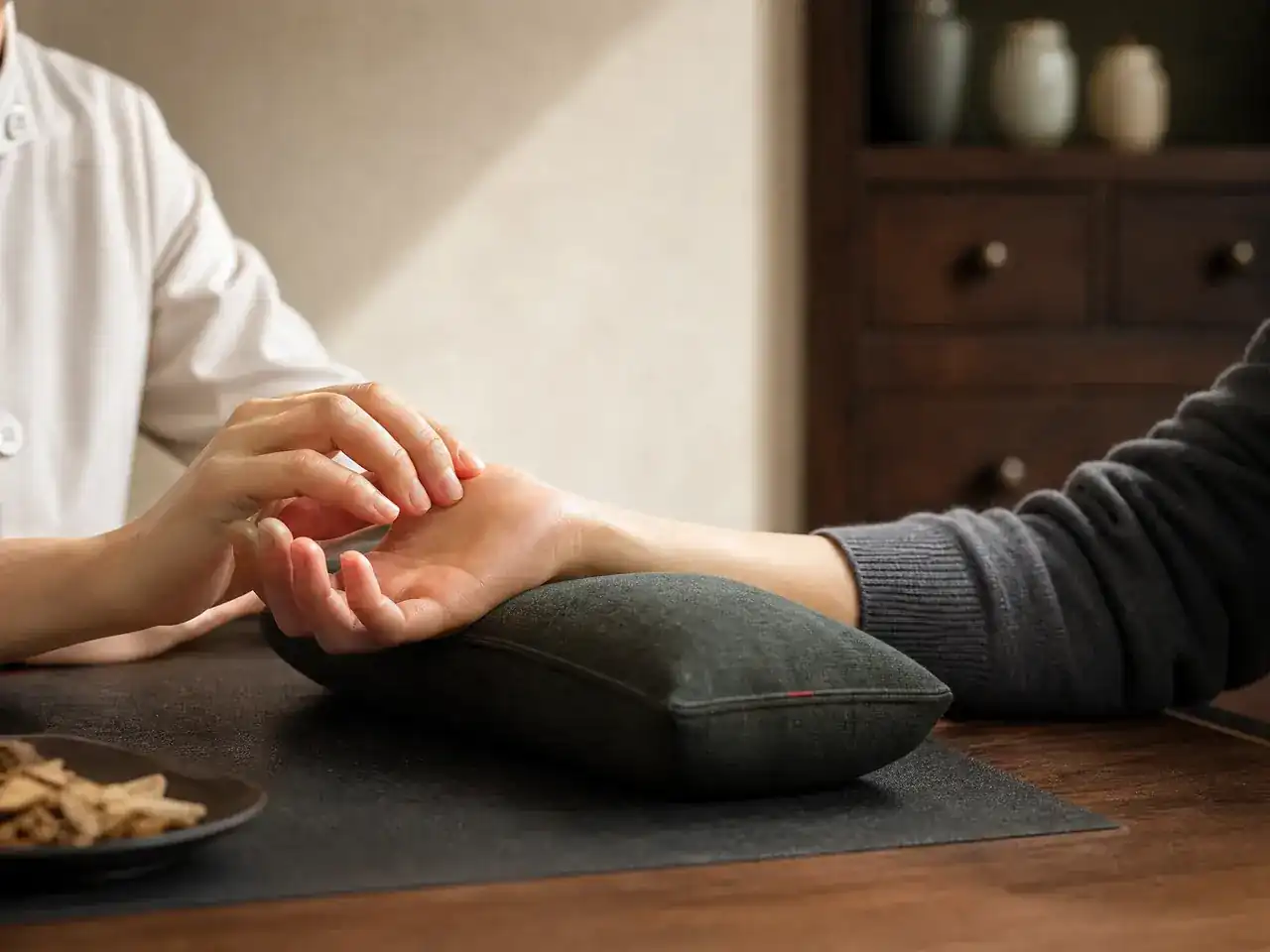
At Harmonia TCM, we understand that every patient's sprain condition and constitution are unique. Therefore, before initiating any sprain treatment, our TCM practitioners conduct a detailed consultation and assessment. This involves understanding how the injury occurred, the current presentation of symptoms, past medical history, and the overall physical condition. By utilizing traditional TCM diagnostic methods—observation, auscultation and olfaction, inquiry, and pulse taking—the practitioner can accurately gauge the patient's Qi and blood status and the patency of the meridians.
In addition to traditional diagnostic methods, the practitioner will also observe the patient's mobility and functional status, assessing the range of motion and stability of the joint. This comprehensive assessment helps in formulating a personalized pain management plan. We emphasize that TCM assessment and support are based on the unique needs of each patient, aiming to provide appropriate care recommendations rather than guaranteeing specific outcomes. Through in-depth communication, we hope to ensure that patients fully understand their condition and the available care options.
Common Grades and Symptoms of Ankle Sprains
Ankle sprains are generally classified into three grades based on the extent of ligament damage. Understanding these grades can help patients better recognize their injury and provide useful information when seeking professional medical assistance. A Grade 1 sprain is considered mild, involving only slight stretching of the ligament. The local area may experience mild pain and swelling, but joint stability is usually unaffected, and the patient can typically still walk, albeit with some discomfort.
A Grade 2 sprain is moderate, involving a partial tear of the ligament. In this case, pain and swelling are more pronounced, bruising may appear locally, the joint's range of motion is restricted, and walking becomes difficult and painful. A Grade 3 sprain is the most severe, involving a complete tear of the ligament. The patient will experience intense pain, severe swelling, and extensive bruising. The joint becomes highly unstable, and it is usually impossible to bear weight or walk. For severe sprains, it is essential to seek prompt conventional medical imaging and assessment.
| Sprain Grade | Ligament Damage | Common Symptoms | Joint Stability |
|---|---|---|---|
| Grade 1 (Mild) | Slight stretching, no significant tear | Mild pain, slight swelling | Stable, usually able to walk |
| Grade 2 (Moderate) | Partial tear | Moderate to severe pain, noticeable swelling, bruising | Mild instability, difficult to walk |
| Grade 3 (Severe) | Complete tear | Intense pain, severe swelling, extensive bruising | Highly unstable, unable to bear weight |
Diverse Approaches in TCM Pain Management
TCM offers a variety of care methods when managing ankle sprains and related pain conditions. These methods aim to promote local Qi and blood circulation, relieve tension in muscles and ligaments, and support the body's self-repair mechanisms. Common approaches include acupuncture, Tui Na (Chinese therapeutic massage), cupping, as well as the external application and internal consumption of Chinese herbal medicine. Acupuncture, by stimulating specific acupoints, helps regulate the flow of Qi and blood in the meridians; Tui Na uses manual techniques to relax local soft tissues and improve joint mobility.
Cupping can help promote local blood circulation and reduce swelling, while the application of Chinese herbal medicine provides targeted support based on the patient's constitution and the stage of the injury. It is important to note that the application of these TCM methods must be assessed and recommended by a registered TCM practitioner based on the patient's specific condition. Harmonia TCM is committed to providing professional consultations to help patients understand the characteristics and applicability of various methods, and to formulate a suitable care plan while ensuring safety.
Daily Care and Preventing Recurrence
In addition to seeking professional sprain treatment, patients should also pay attention to appropriate daily care to promote recovery and prevent re-injury. In the early stages of a sprain, proper rest, ice application, compression, and elevation of the affected area (the PRICE principle) are common initial management steps. As symptoms alleviate, gradually introducing appropriate joint mobility and muscle-strengthening exercises can help restore joint stability and function.
Preventing the recurrence of an ankle sprain is equally important. This includes adequate warm-up before physical activities, wearing footwear that provides good support, and avoiding high-risk activities on uneven or slippery surfaces. TCM also emphasizes enhancing the body's resistance and recovery capabilities by harmonizing the constitution. The TCM practitioners at Harmonia TCM will provide relevant dietary and lifestyle advice based on your constitution, helping you maintain good health in your daily life.
Frequently asked questions
Should I seek TCM treatment immediately after an ankle sprain?
In the initial stage of a sprain, the priority is to rule out conditions that require immediate conventional medical intervention, such as fractures or severe ligament tears. If symptoms are severe, it is recommended to seek a Western medical assessment first. After ruling out severe structural damage, you can consider seeking a TCM pain management assessment to help alleviate symptoms and promote recovery.
How long does TCM sprain treatment usually take to show results?
Recovery time varies depending on the severity of the sprain, individual constitution, and daily care. TCM care aims to support the body's natural repair process and does not provide immediate or guaranteed results. The TCM practitioner will discuss the expected care progress and follow-up arrangements with you based on your specific condition.
Is acupuncture painful when managing an ankle sprain?
The needles used in acupuncture are very fine. Most people only feel a slight prick or a dull ache upon insertion, which is generally considered a normal 'De Qi' response. If you have concerns about acupuncture, please communicate with the TCM practitioner during the assessment, and they will adjust the care plan according to your comfort level.
What can I do at home besides receiving care at the clinic?
Daily care is crucial for recovery. The TCM practitioner will provide specific advice based on your condition, which may include appropriate rest, local care, and gentle joint mobility exercises in the later stages of recovery. Please follow the practitioner's guidance and avoid engaging in strenuous activities too early to prevent re-injury.
Does Harmonia TCM offer home visit assessments for ankle sprains?
Harmonia TCM's only physical clinic is located in Kwun Tong. The services and arrangements described here (including any reference information regarding home visits) are subject to final confirmation by a registered TCM practitioner and the clinic. Please contact us to learn about the latest service arrangements and availability.
Can TCM still help if my sprain has developed into chronic pain?
For chronic ankle pain, TCM will assess your overall constitution and long-term Qi and blood status. Through methods such as acupuncture, Tui Na, or herbal medicine, TCM pain management aims to help improve local circulation and alleviate persistent discomfort. We recommend scheduling a consultation for a detailed assessment by our practitioner.
Related topics
Sources
Schedule a Professional TCM Assessment
Learn more about TCM pain management plans for ankle sprains. Please note that service availability, suitability and arrangements require individual confirmation. If you are considering care, we can first discuss what may suit you and how an appointment can be arranged.